Explainer
What is an inverter? How solar and battery inverters work
An inverter turns the DC from panels and batteries into the AC your house runs on. The spec sheet numbers that matter are continuous power, surge power, idle draw and efficiency.
On this page
DC in, AC out
The U.S. Department of Energy describes an inverter as a device that converts direct current (DC), which is what a solar panel generates, into alternating current (AC), which the electrical grid uses. In DC the voltage stays constant and the current flows one way. In AC the voltage swings between positive and negative, so the current flows back and forth. Batteries store and deliver DC; the grid and household appliances use AC.
The conversion works by switching the DC input back and forth very rapidly. Filters and other electronics then smooth the result into a clean, repeating sine wave. Today the switches are transistors, which have no moving parts.
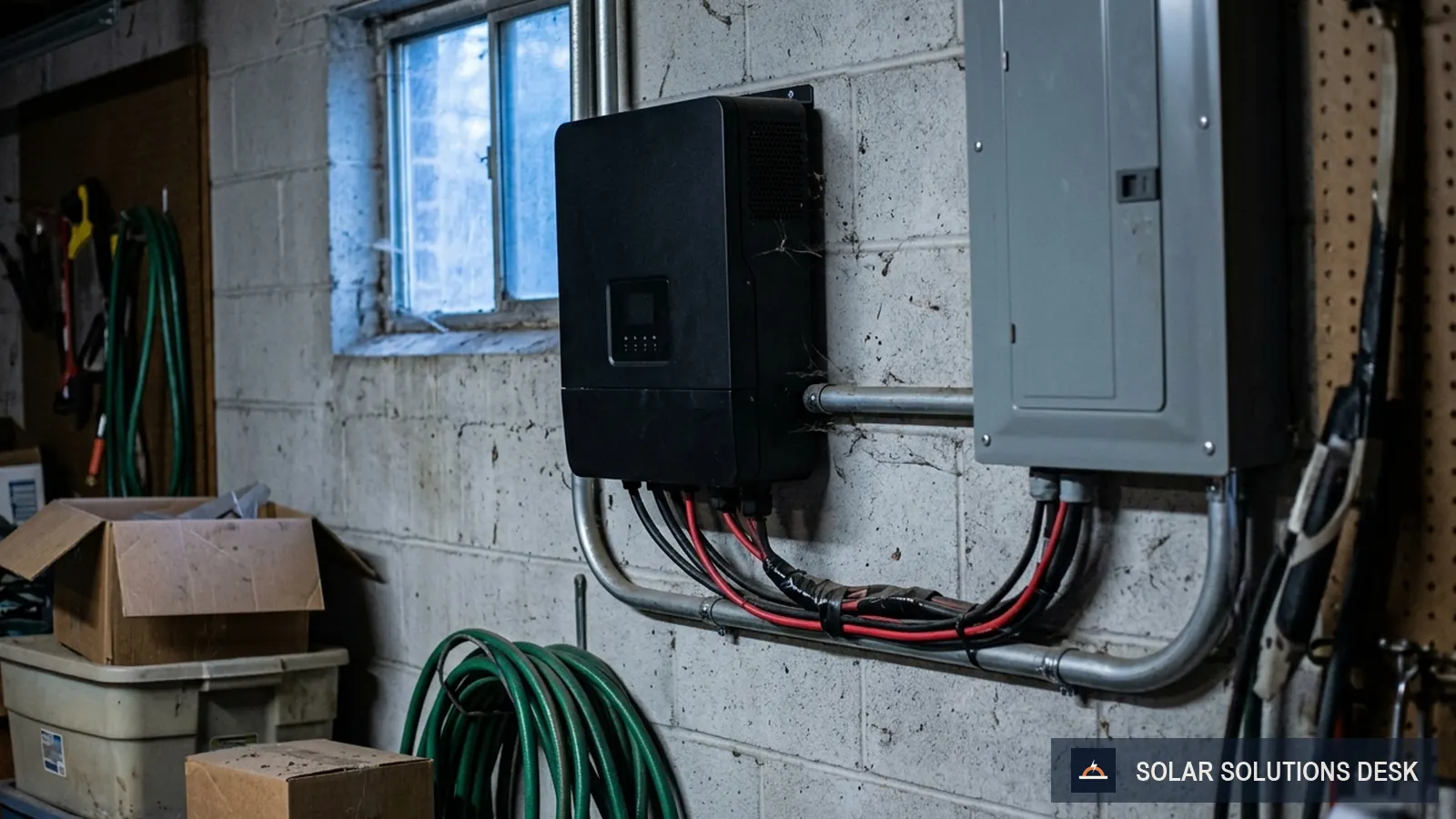
Three kinds of home inverter
Which kind you need depends on whether the house stays connected to the grid and whether you want power during an outage. The names are loose in the trade, so treat this table as a way to ask the right question of any product.
| Type | What it connects to | During a grid outage |
|---|---|---|
| Grid-tied (solar only) | Panels and the grid | Generally switches off for safety, so no power from the panels alone |
| Hybrid | Panels, battery and the grid | Can run the house from battery and solar if configured to |
| Off-grid | Panels and battery, no utility required | Not affected, because it does not depend on the grid |
The DOE is blunt about the first row: residential solar panels alone are not enough to make a home resilient, because solar systems generally depend on the grid and are designed to switch off if grid power cuts out. To produce power on their own they need a properly configured inverter and a storage system. There is a technical reason for the difference. A traditional grid-following inverter needs the grid to supply a signal to match; a grid-forming inverter can generate that signal itself. Our page on what happens to solar when the grid goes down goes through this in detail.
Makers describe their own products in these terms. EG4 calls the 6000XP a 48 V off-grid inverter/charger that can run entirely off the grid or with grid input for supplemental charging and output. It calls the 18kPV a hybrid inverter/charger that can run entirely off the grid, use grid assist, or sell power back to the grid. If you are still choosing between these designs, read off-grid, hybrid or grid-tied.
One box or several
The DOE also describes how inverters are arranged. A string inverter converts the power from a whole string of panels, which costs less but means shade on one panel can reduce the whole string. A microinverter sits on each panel, which avoids that but can cost more. In a battery system the battery can be charged from solar directly over DC, or after a conversion to AC. An all-in-one hybrid or off-grid unit like those above puts the inverter, battery charger and solar charge controllers in one cabinet.
Sine wave, and why it matters
The grid delivers voltage as a sine wave, and equipment is built to operate at certain voltages and frequencies, so a sine wave is the pattern of power that does not damage it. Maker sheets quantify how clean the output is with total harmonic distortion (THD) at full load: under 3% for the EG4 6000XP and 12000XP, under 5% for the 18kPV, and the 3000EHV-48 sheet lists its output waveform as pure sine wave. Lower THD means the output is closer to a textbook sine wave. Treat any inverter that does not state its waveform and THD as an open question.
Two power numbers: continuous and surge
An inverter has a continuous rating, which it can hold indefinitely, and a surge rating, which it can hold only briefly. Motors, compressors and pumps draw a burst of power when they start, and the surge rating is what covers that burst. The duration matters as much as the number.
| Example inverter | Continuous | Surge, as stated |
|---|---|---|
| EG4 6000XP | 6,000 W | 12,000 W for about 3.5 s; 11,000 W for about 5 s |
| EG4 12kPV | 8,000 W | 16 kW for 0.5 s; 12 kW for 1 s; 10 kW for 1 min; 8.8 kW for 12 min |
| EG4 3000EHV-48 | 3 kW | 2 times rated power for 5 s |
These are labelled examples from the makers' sheets, not a recommendation. Arithmetic on the last row: twice 3 kW is 6 kW for five seconds. A surge figure only helps if the starting load fits inside both the number and the time. That is the reason a well pump can trip an inverter that looks big enough on paper; we explain it in why a well pump trips your inverter.
Also check the voltage the continuous number applies to. The 18kPV sheet lists 12,000 W at 240 V but 10,400 W at 208 V. The 3000EHV-48 sheet gives its output as 3 kVA / 3 kW. Power in watts is what runs your loads, so compare watts with watts.
What an inverter costs you to run
Two figures on the sheet decide how much of your stored energy never reaches a light bulb: idle consumption and efficiency.
Idle draw
Idle (standby) consumption is the power the inverter uses while supplying nothing. The 6000XP sheet lists under 30 W with solar present, about 50 W on battery and under 50 W on AC, and notes the value was tested with a constant 300 VDC PV source. The 12000XP lists under 70 W. The 18kPV lists about 70 W in normal mode and about 18 W in standby mode. The arithmetic over a full day (our calculation):
Against a 5.12 kWh battery, 1.2 kWh is about 23% of the stored energy (1.2 ÷ 5.12). Idle draw belongs in any runtime estimate; the runtime calculator is the place to apply it.
Efficiency
Sheets quote efficiency for specific paths, and the path matters. The 6000XP sheet lists 93% for battery discharging. The 12000XP lists a maximum of 90.2% from battery to loads, along with 93.5% from PV to loads. The 18kPV lists 94% maximum from battery to grid and 97.5% from PV to grid. A maximum is by definition a best case. To see what a loss means in practice:
The difference between 93% and 90.2% is small on one day and visible over a long outage. Never compare a "PV to grid" number on one sheet with a "battery to loads" number on another.
Split-phase output in one paragraph
Split-phase output is how an inverter provides both 120 V and 240 V from one unit. EG4 describes the 6000XP as a 208/240 VAC split-phase inverter with a transformerless, high-frequency split-phase design that provides 120/240 V from a single unit, and says the 18kPV allows 120/240 V from a single unit or 120/208 V service operation. The choice between 240 V and 208 V service changes the output rating, as the 18kPV figures above show. The service voltage at your panel is something the installer confirms, not something to guess from a product page.
What to look at on a spec sheet
- Continuous output at your voltage. Watts at 240 V or 208 V, not the headline number.
- Surge and its duration. Compare against the starting power of your biggest motor.
- Battery voltage. The EG4 inverters above are 48 V-class; see why battery systems use 48 V and make sure the battery matches.
- Idle consumption in the mode you will actually use.
- Efficiency for the path you care about, and whether it is a maximum.
- Waveform and THD.
- Solar input limits. Voltage range and recommended maximum solar power. A recommended maximum for panels is not an output rating.
- Warranty and certification. The sheets list these; read them, then check them against the model number you are buying.
Our inverter buying guide applies these checks across the EG4 range, and the inverter comparison lines the sheets up side by side. Terms are defined in the glossary.
Common mistakes
- Reading panel capacity as inverter output. Recommended solar input and rated AC output are different lines on the same sheet.
- Sizing only on continuous watts. A pump or compressor that starts under load needs the surge number and its duration.
- Ignoring idle draw. It runs all day, every day.
- Assuming a grid-tied system gives backup. Without a configured inverter and storage it does not.
- Treating one efficiency number as the whole story. Check which path it describes.
Inverter and battery connections carry high currents. Have the installation designed and inspected by a licensed electrician under your local code.
Questions people ask
What does an inverter do in a solar system?
It converts the direct current (DC) that solar panels and batteries produce into alternating current (AC), which is what the grid and household appliances use. Many household inverters also monitor the system and connect it to a network.
What is the difference between a grid-tied, hybrid and off-grid inverter?
A grid-tied inverter feeds solar power into a house connected to the grid and generally shuts down when the grid fails. A hybrid inverter also manages a battery and can run the house without the grid. An off-grid inverter is built to run the house from batteries and solar, with no utility connection required.
Does an inverter use power when nothing is plugged in?
Yes. Spec sheets list an idle or standby consumption. The EG4 6000XP sheet lists about 50 W on battery and under 30 W with solar present; at 50 W that is 1,200 Wh over 24 hours (our calculation).
What is the difference between continuous and surge power?
Continuous power is what the inverter can supply without a time limit. Surge (peak) power is a higher figure it can supply only for a short, stated time, such as 12,000 W for about 3.5 seconds on the EG4 6000XP, to cover motors starting.
Do I need a pure sine wave inverter?
Grid power is a sine wave and household equipment is built for that shape, so an inverter that outputs a clean sine wave with low distortion is the safe choice. Maker sheets list distortion (THD): under 3% at full load for the EG4 6000XP and 12000XP, under 5% for the 18kPV.
Where do I find an inverter's real specs?
On the maker's spec sheet, not the marketing headline. Look for continuous output at your voltage (240 V or 208 V), surge power and its duration, battery voltage, idle consumption, and which efficiency figure (battery to loads, PV to grid) is being quoted.
Read next
Watts vs watt-hours: power and energy, explained
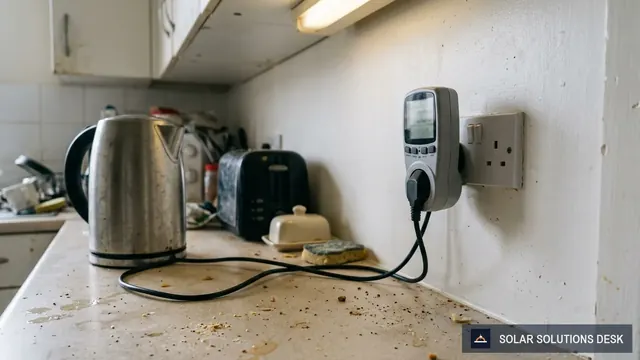
A watt measures power at a moment; a watt-hour measures energy over time. A 1,000 W heater running for one hour uses 1 kWh.
What is a LiFePO4 battery? LFP vs lead-acid explained
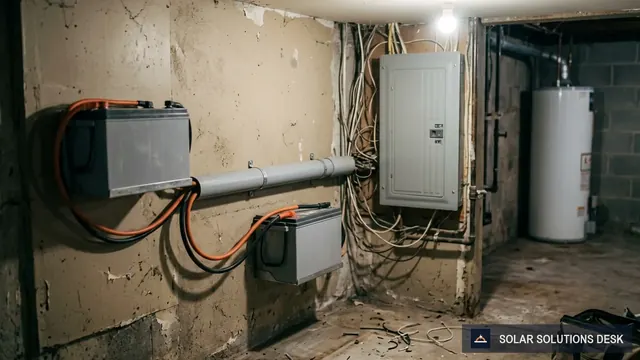
LiFePO4 (LFP) is a lithium-ion chemistry with an iron phosphate cathode. It trades energy density for long cycle life and thermal…
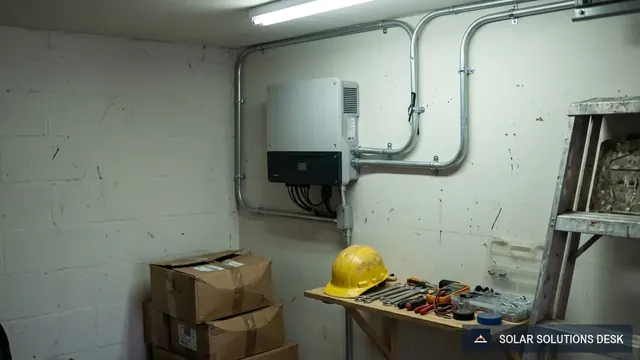
How to choose a solar inverter: five questions before you compare models
Decide grid or no grid, biggest start-up load, future solar, battery compatibility and location. Then compare models within one family.