Explainer
What is a LiFePO4 battery? LFP vs lead-acid explained
LiFePO4 is lithium iron phosphate, the chemistry in most home backup batteries. What it is, what its cycle-life and temperature numbers really say, and what it does not fix.
On this page
What the name means
LiFePO4 is the chemical formula for lithium iron phosphate, shortened to LFP. In Battery University's description the cell has a lithium iron phosphate cathode and a graphite anode, and phosphate was discovered as a cathode material in 1996. EG4's sheets use both spellings: the 314Ah indoor sheet says "LFP" and "Lithium Iron Phosphate (LFP)", and the LifePower4 sheet says "Lithium Iron Phosphate". They mean the same thing. LFP is a type of lithium-ion battery, not a separate technology family, and it has become the main chemistry for stationary storage: the 2024 NREL Annual Technology Baseline says LFP became the primary chemistry for stationary storage starting in 2021.
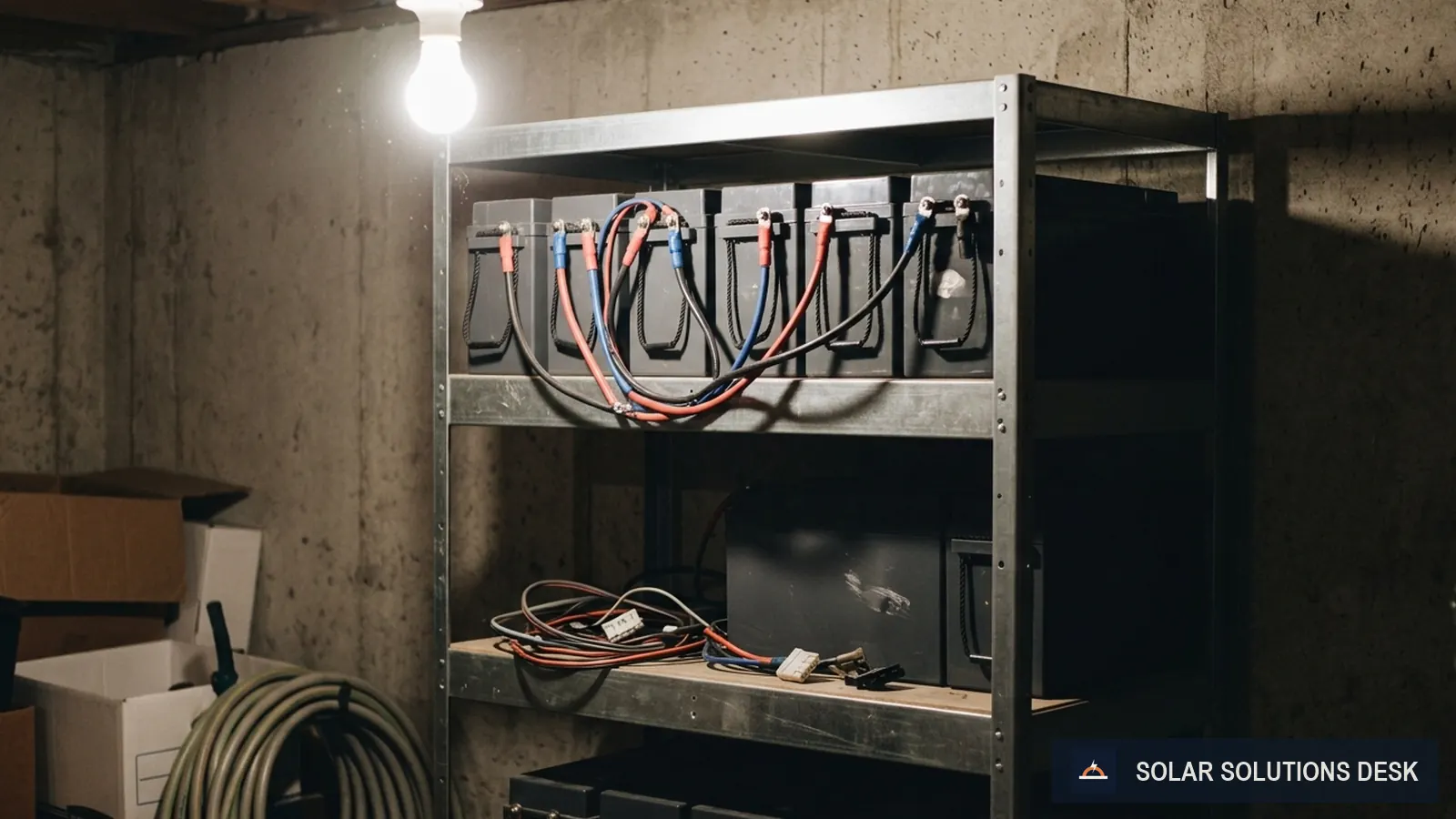
The cell: 3.2 V, and why 16 make 51.2 V
Battery University gives lithium iron phosphate a nominal voltage of 3.20 V (some makers say 3.30 V) per cell, with a typical operating range of 2.5 to 3.65 V per cell. Cells connect in series to reach a pack voltage, and the arithmetic is simple:
That is why a "48 V" lithium battery is labelled 51.2 V and why the voltage on EG4 sheets is always 51.2 V (the inverters are described as 48 V-class; see why battery systems use 48 V). Lead acid reaches the same neighbourhood a different way. Battery University rates lead acid at 2 V per cell, so a 48 V lead-acid bank takes 24 cells (24 × 2 V, our arithmetic). Four LFP cells in series make 12.8 V, close to the voltage of six lead-acid cells, which is why LFP is often used to replace 12 V lead-acid starter batteries.
The cell voltage also explains the charging numbers on EG4's sheets. The 314Ah indoor sheet lists a charging voltage range of 56 to 57 V and a discharge cut-off of 47.5 V. Divided by 16 cells (our calculation) that is about 3.50 to 3.56 V per cell on charge and 2.97 V per cell at cut-off, inside the 2.5 to 3.65 V range above. The BMS on the LifePower4 trips charge at 3.8 V per cell and discharge at 2.3 V per cell.
LFP versus lead acid
Lead acid is the older home-storage chemistry. These figures come from Battery University, which lists typical values, not the specifications of any one product:
| LFP | Deep-cycle lead acid | |
|---|---|---|
| Nominal cell voltage | 3.2 V | 2 V |
| Cycle life | 2,000 and higher, depending on depth of discharge and temperature | 150 to 200 cycles at 100% depth of discharge, 400 to 500 at 50%, 1,000 and more at 30% |
| Typical full charge | About 3 hours at 1C | 14 to 16 hours for most types |
| Cold | Cold reduces performance | Works well at cold temperatures, superior to lithium-ion in subzero conditions |
| Cost per kWh | Higher (Battery University lists high cost per kWh as a lithium-ion weakness) | Among the lowest of any battery |
The two cycle-life rows use different test depths, so do not read them as a ratio. The pattern, though, is clear: lead acid wears fastest when it is discharged deeply, and a battery cycled every day for solar storage is discharged often. Battery University adds that lead acid must be stored at full charge to avoid sulfation. Lead acid still wins on up-front cost and in subzero cold, which is a fair reason to choose it for a seldom-used system in an unheated space.
Why home batteries use LFP
- Cycle life. Daily solar storage means many cycles, and LFP's cycle-life figures are far higher than lead acid's (see the table above and the datasheet figures below).
- Stability when full. Battery University says LFP is more tolerant of being held at a full charge than other lithium-ion types.
- Thermal behavior. Researchers at Oak Ridge and Sandia National Laboratories cite measured thermal-runaway onset at 246 °C for LFP cells, against 104 to 144 °C for most other chemistries. Battery University gives a thermal-runaway temperature of 270 °C (518 °F) for LFP.
- High current. Battery University lists a high current rating as a key LFP benefit.
The price of those benefits is lower energy per kilogram. Battery University lists LFP at 90 to 120 Wh/kg, calls it low-capacity, and notes an elevated self-discharge that can cause balancing issues as cells age, which better control electronics can mitigate at higher cost. This is why wall batteries are heavy: the 314Ah indoor unit weighs 293.2 lbs for 16 kWh.
Cycle life, as EG4 states it
These are the maker's datasheet figures, copied with their test conditions. They are lab results, not promises about your system.
| EG4 battery | Cycle life as stated | Other stated life |
|---|---|---|
| WallMount 314Ah Indoor | 10,000 cycles at 0.5C, 25 °C, 80% DOD (70% end-of-life capacity) | Design life 10 years; warranty 10 years or 10,000 cycles |
| WallMount Indoor 280Ah | More than 8,000 cycles, 0.5C, 80% DOD | Design life more than 10 years |
| WallMount Indoor 100Ah | More than 6,000 cycles, 0.5C, 80% DOD | Design life more than 15 years |
| LifePower4 48V V2 | More than 6,000 deep discharge cycles to 80% DoD | 10-year standard warranty |
| LL-S 48V 100Ah | More than 7,000 deep charge and discharge cycles | 10-year warranty |
Read the footnotes the way the maker wrote them. The 314Ah figure is 10,000 cycles to 70% of original capacity, so the battery is not "dead" at 10,000 cycles but also is not at full capacity. One cycle a day for 10,000 cycles is 27 years (10,000 ÷ 365, our calculation), yet the same sheet lists a 10-year design life and a warranty line of “10 years or 10000 cycles”; the sheet does not say which limit ends coverage first. The sensible reading is that the cycle number is a test result and the years are the maker's commitment. Both assume 80% depth of discharge, and EG4 recommends setting the low-charge cutoff no lower than 20% to hold to it. Compare batteries using the same depth and rate; our battery comparison lists them together.
Temperature limits from the datasheets
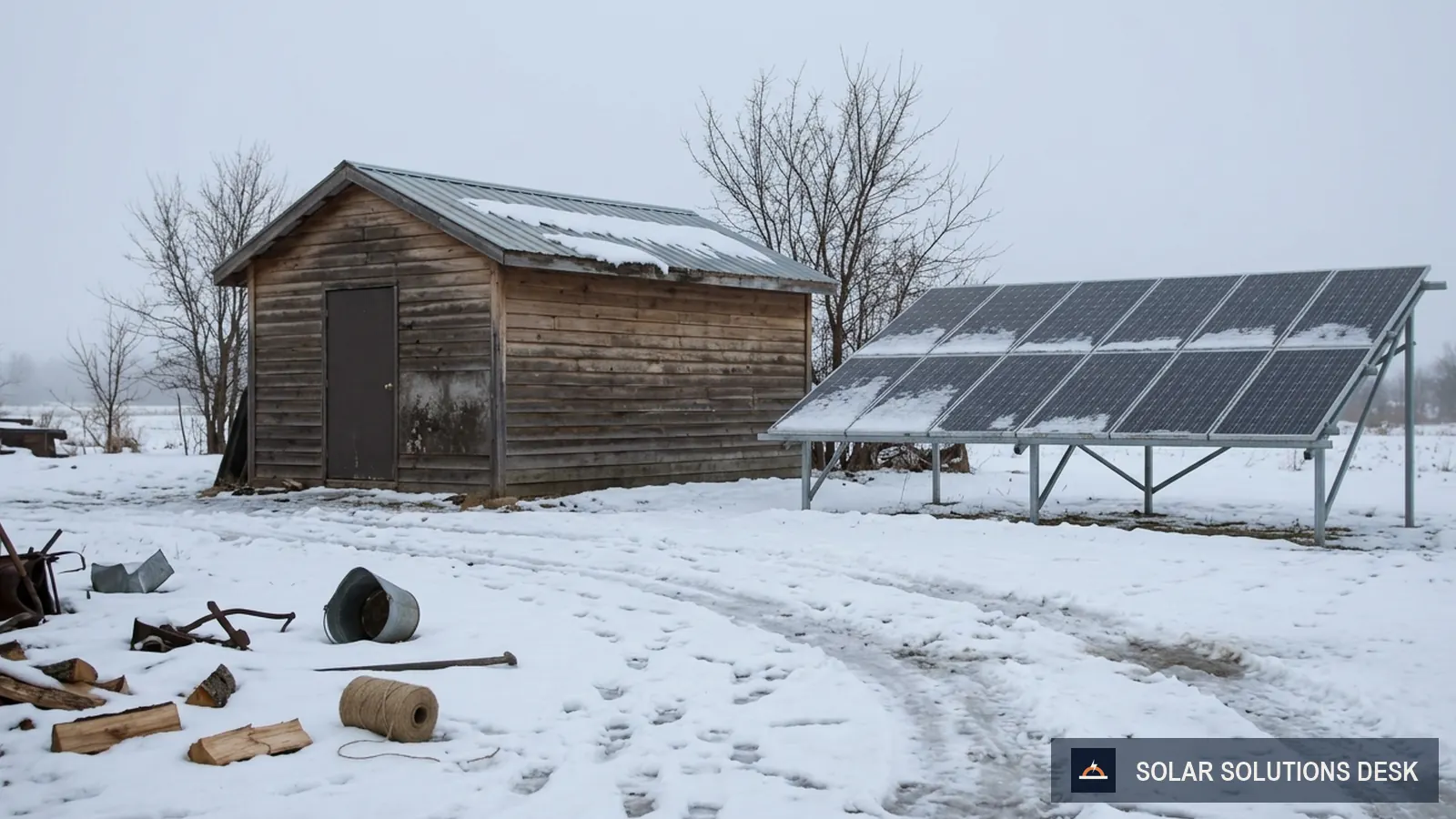
This is where LFP disappoints people with outbuildings and cold garages. The 314Ah indoor sheet lists charging from 32 to 122 °F (0 to 50 °C) and discharging from -4 to 131 °F (-20 to 55 °C). The 100Ah, 280Ah and LL-S sheets give the same ranges. Charging is the restricted direction. Battery University explains why for lithium-ion in general: charging below freezing can plate metallic lithium on the anode, a permanent loss of performance and safety, and the cell appears to charge normally while it happens.
Some EG4 models address this with a heater. The 280Ah indoor sheet lists an integrated self-heating feature that turns on at an internal temperature of 32 °F (0 °C) or below and off at 41 °F (5 °C), drawing 224 W while it runs. The 314Ah sheet lists a 448 W heater with a 37 °F (3 °C) turn-off. That heater power comes from somewhere, which matters in winter; for the planning side, see how to size solar for your worst month. EG4 sheets are not identical across revisions. One earlier LifePower4 V2 revision (model SR-48-100-LP4-IN-02) lists a narrower charging range of 32 to 113 °F (0 to 45 °C), so confirm the sheet for the exact model number on your battery.
Safety features the maker lists
These are EG4's own descriptions, the maker’s own descriptions, which we have not tested:
- The 314Ah indoor sheet lists internal fire arrestors, reinforced cell enclosures and an integrated BMS with active balancing.
- The 280Ah indoor sheet lists dual on-board fire arrestors that "offer fail-safe protection against thermal runaway" and an optional emergency-stop disconnect.
- The LifePower4 and LL-S sheets describe dual on-board fire arrestors and E-stop functionality.
- The sheets list protections for over- and under-voltage, over-current, short circuit and high and low temperature.
- The 314Ah sheet lists UL 1973 and UL 9540A as "Yes".
A BMS is a control board that watches cells and cuts the battery off outside its limits. It is not optional equipment. Even the maker's own protection thresholds differ by sheet, so use the sheet for your model.
What LFP does not fix
- It can still burn. A 2024 review from the University of Sheffield and collaborators found that NMC cells make larger volumes of off-gas, but LFP off-gas reaches its lower flammability limit (6.2%, against 7.9% to 9.2% for NMC) in a volume 18% smaller, so the authors conclude LFP presents a greater flammability hazard even though flames occur less often. The same review found LFP significantly more toxic than NMC in absolute terms, with the result depending on state of charge. The Oak Ridge and Sandia work found LFP cells scored low on a hazard scale because heating was mainly joule heating with no significant chemical reaction triggered. The two findings can both be true: one measures how severe a cell failure is under mechanical abuse, the other what gas a failed cell releases.
- It can still deliver a huge current. The 314Ah sheet lists a short-circuit current of 1,700 A. Wiring, fusing and clearances are a code matter. Installation needs a licensed electrician following local code.
- It does not charge in the cold. See the limits above.
- It is not light or small. Plan for the weight of the wall or the floor.
- It does not make cycle numbers automatic. Depth of discharge, rate and temperature all change them.
Before you buy
- Match voltage and communication with the inverter; see how to choose an inverter.
- Check the charging temperature range for where the battery will sit.
- Compare cycle life at the same depth of discharge and rate.
- Convert capacity to usable energy; see amp-hours vs watt-hours and how much battery do you need.
- Confirm the revision of the spec sheet for your exact model number.
Terms such as BMS, depth of discharge and nominal capacity are in the glossary.
Related: battery capacity units are explained in amp-hours vs watt-hours, and the device that draws on the battery is covered in what an inverter is and how it works.
Questions people ask
What does LiFePO4 stand for?
Lithium iron phosphate. Its short form is LFP. The cathode is lithium iron phosphate and the anode is graphite.
Why does a 48 V lithium battery say 51.2 V?
A lithium iron phosphate cell is about 3.2 V nominal. Sixteen cells in series give 16 × 3.2 = 51.2 V. EG4's LifePower4 sheet describes its pack as 16 prismatic 3.2 V cells in series.
Can you charge a LiFePO4 battery in freezing weather?
EG4's datasheets list charging from 32 °F (0 °C) up to 122 °F (50 °C), and discharging from -4 °F (-20 °C). Battery University warns that charging lithium-ion below freezing can plate lithium on the anode and permanently degrade it. Some EG4 models include internal heaters.
How many cycles does a LiFePO4 battery last?
It depends on the model and test conditions. EG4 states 10,000 cycles for the WallMount 314Ah, more than 8,000 for the 280Ah and more than 6,000 for the 100Ah, at 80% depth of discharge and 0.5C. Battery University lists 2,000 and higher for LFP generally.
Is LiFePO4 fireproof?
No. It has a higher thermal-runaway onset temperature than most lithium-ion chemistries, but a 2024 review found LFP off-gas has a greater flammability hazard than NMC. Makers add a BMS and, on EG4 batteries, internal fire arrestors. Installation still needs a licensed electrician.
Is LiFePO4 better than lead-acid?
For daily cycling it generally lasts far more cycles and charges faster, per Battery University. Lead acid is cheaper per kilowatt-hour and works better in subzero cold. Which is better depends on how hard and how often you cycle the battery.
Read next
Watts vs watt-hours: power and energy, explained
A watt measures power at a moment; a watt-hour measures energy over time. A 1,000 W heater running for one hour uses 1 kWh.
How to choose a solar inverter: five questions before you compare models
Decide grid or no grid, biggest start-up load, future solar, battery compatibility and location. Then compare models within one family.
Amp-hours vs watt-hours: how to convert and compare batteries
Watt-hours equal amp-hours times volts. A 100 Ah battery holds 1,200 Wh at 12 V but 5,120 Wh at 51.2 V, so Ah alone misleads.